
What Is Digital Marketing?
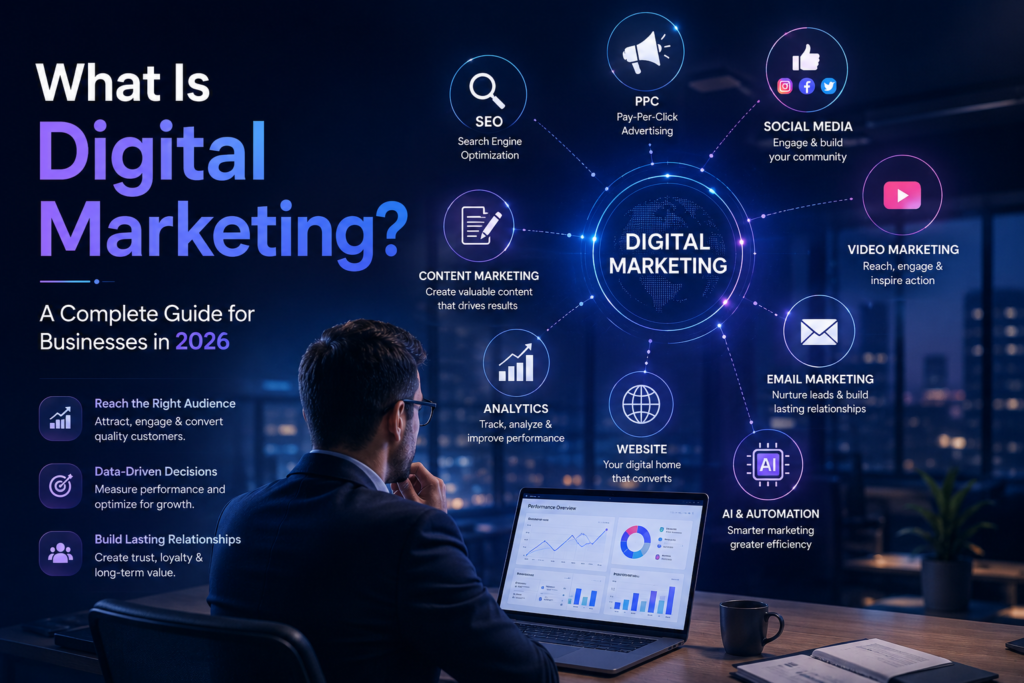
Digital marketing is the process of using digital channels, platforms, technologies, and data to promote a business, connect with customers, generate leads, increase sales, and build long-term brand relationships.
Unlike traditional marketing, which may rely heavily on television, print, radio, or outdoor advertising, It allows businesses to reach audiences through search engines, websites, social media, email, online advertising, video platforms, mobile devices, and other digital touchpoints.
Google describes digital marketing as a field that combines technology, creativity, strategy, and real-time data to connect businesses with their audiences. It includes activities such as SEO, paid advertising, social media, email, content creation, analytics, and conversion optimization.
For businesses in 2026, marketing is no longer simply about having a website or posting regularly on Instagram. It is about creating an interconnected system that attracts the right audience, earns attention, builds trust, converts prospects, and retains customers.
The most effective strategy therefore starts with a business objective rather than a particular platform.
Why Is Digital Marketing Important for Businesses in 2026?
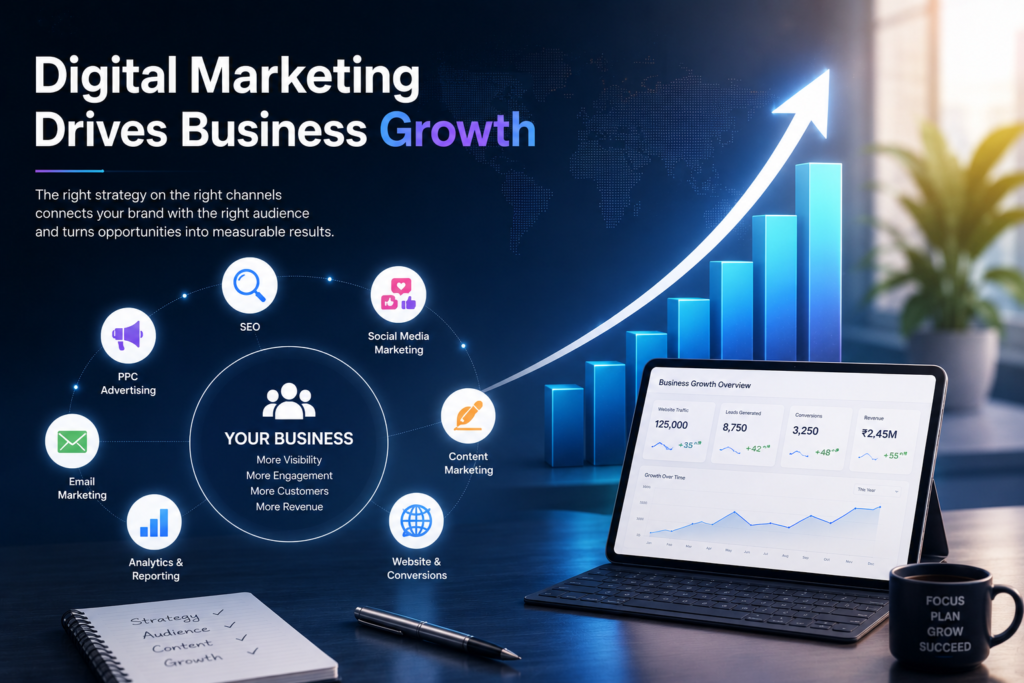
Consumer behavior has changed significantly.
People research businesses online before contacting them. They compare products through search engines, discover brands on social media, watch videos before purchasing, read reviews, subscribe to email lists, and increasingly use AI-powered tools to research questions and recommendations.
This makes digital growth an important part of the modern customer journey.
For businesses operating in India, the opportunity is particularly significant. Ipsos reported that India’s digital advertising spend was projected to reach ₹56,400 crore in FY2026, representing 46% of total advertising spend, while mobile platforms accounted for 78% of digital advertising spend.
This does not mean every business should spend heavily on advertising.
Instead, it demonstrates why businesses need a thoughtful digital marketing strategy that considers where their customers spend time, how they search for information, and what influences their purchasing decisions.
A successful strategy can help businesses:
- Increase brand awareness
- Generate qualified leads
- Reach new audiences
- Increase website traffic
- Improve customer engagement
- Generate online sales
- Build brand authority
- Retain existing customers
- Measure marketing performance
- Improve return on investment
How Does Digital Marketing Work?
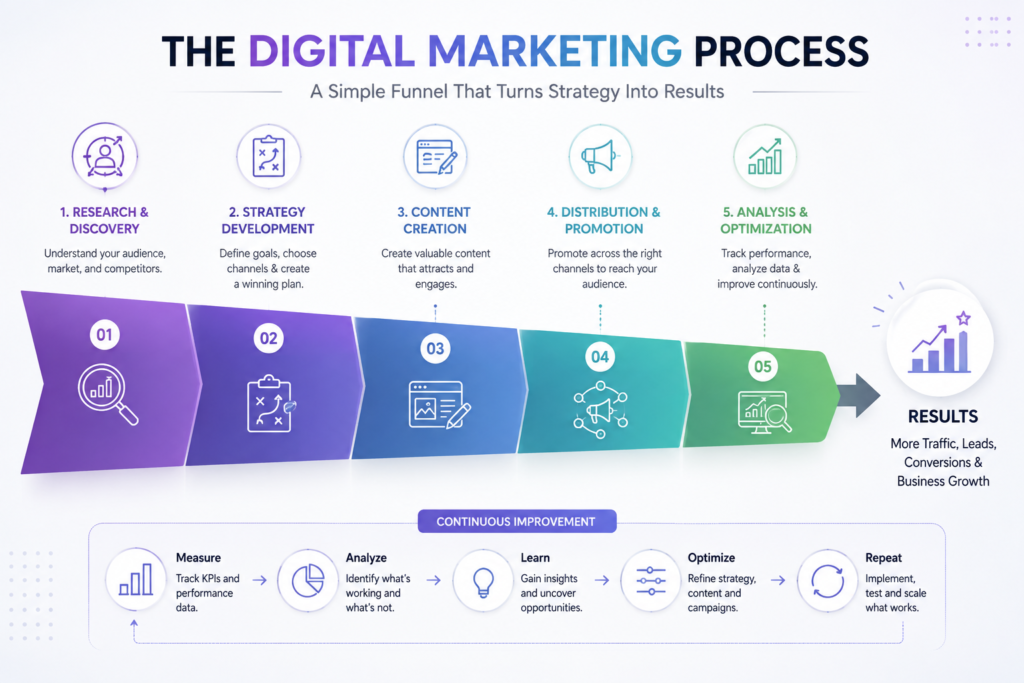
At its core, digital marketing follows a continuous process rather than a one-time campaign.
A simplified framework looks like this:
Research → Strategy → Create → Distribute → Measure → Optimize → Repeat
1. Research
First, businesses need to understand their market.
Research should cover:
- Target customers
- Customer needs
- Competitors
- Search behavior
- Buying motivations
- Pain points
- Preferred platforms
- Existing brand perception
2. Strategy
The research is converted into a digital marketing strategy.
This involves deciding:
- What the business wants to achieve
- Who it wants to reach
- Which channels to use
- What content to create
- How much to invest
- Which metrics to track
3. Create
Businesses then develop relevant assets such as:
- Blog posts
- Videos
- Social media content
- Landing pages
- Emails
- Advertisements
- Case studies
- Guides
- Product pages
4. Distribute
The content reaches audiences through relevant channels.
These can include search engines, social platforms, email, paid advertising, websites, communities, and other digital environments.
5. Measure
Analytics reveal what is working.
Businesses can monitor traffic, engagement, conversions, cost per acquisition, revenue, and other key performance indicators.
6. Optimize
The data is then used to improve campaigns.
This continuous process is one of the biggest advantages of digital marketing because businesses can test, learn, and adjust instead of waiting until the end of a campaign to evaluate its performance.
Google similarly describes digital marketing as a continuous process involving planning, content creation, performance monitoring, analysis, and conversion optimization.
Types of Digital Marketing
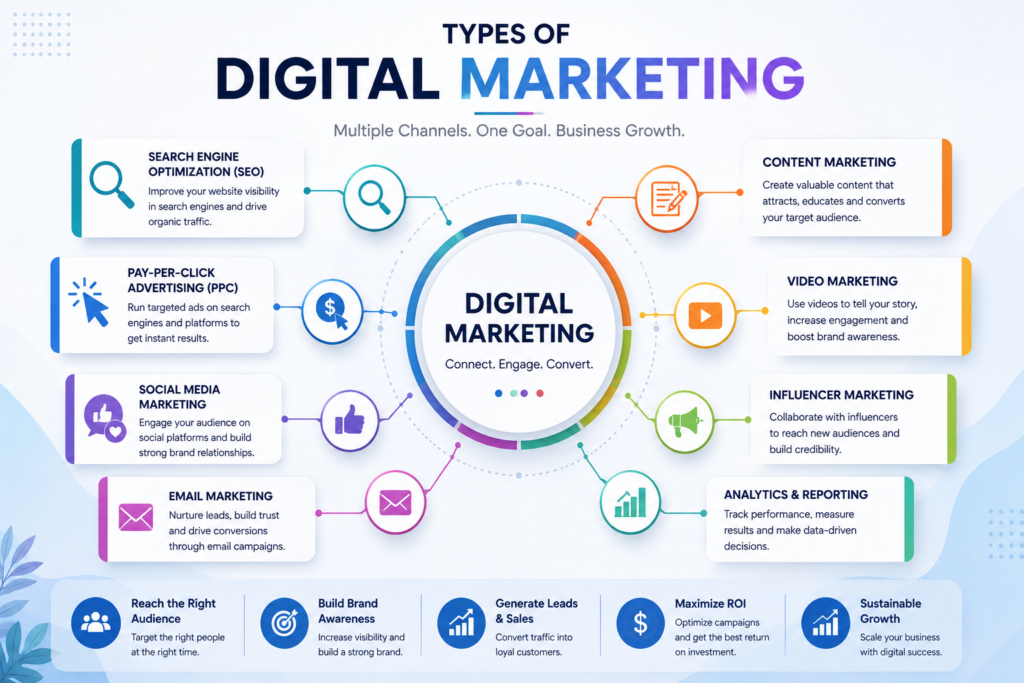
There is no single channel that works for every business.
The right combination depends on the industry, audience, objectives, budget, customer journey, and competitive environment.
Here are the major forms of digital marketing businesses should understand in 2026.
1. Search Engine Optimization (SEO)
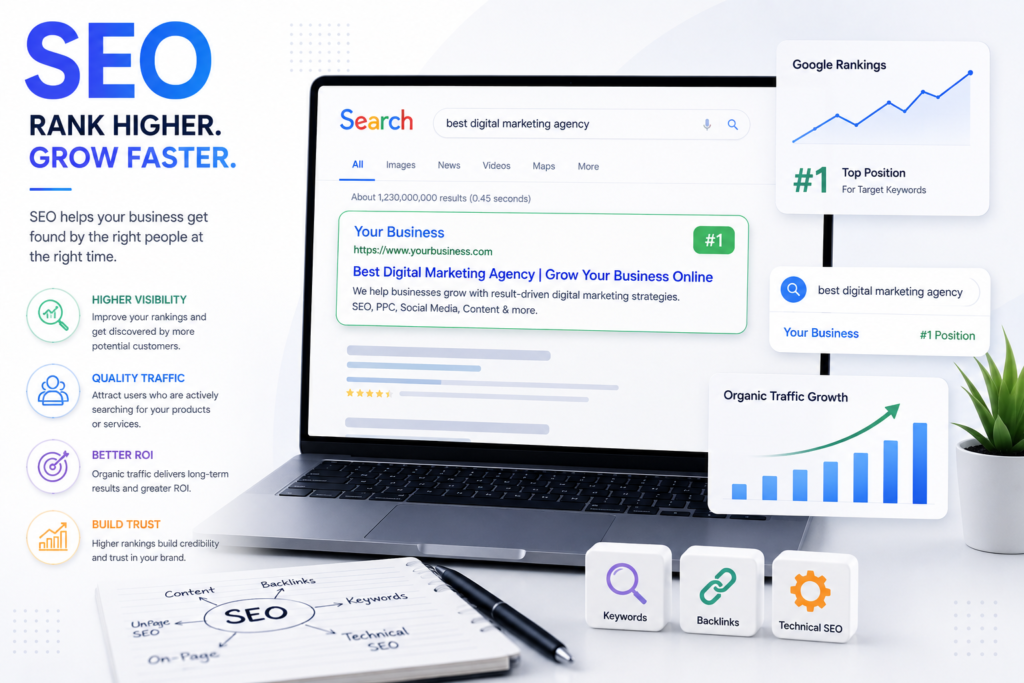
Search Engine Optimization, commonly known as SEO, focuses on improving a website’s organic visibility in search engines.
For example, a person searching:
“best interior designer in Gurgaon”
may see several businesses in the search results.
A strong SEO strategy can help a relevant business appear when potential customers search for its services.
SEO includes:
- Keyword research
- Search intent
- On-page optimization
- Technical SEO
- Internal linking
- Content creation
- Local SEO
- Website architecture
- Structured data
- Authority building
SEO is particularly valuable because it can attract people who already have an interest or need related to a business.
Google’s search guidance emphasizes creating helpful, reliable, people-first content and maintaining technically accessible websites.
2. Search Engine Marketing and PPC
Search Engine Marketing, or SEM, includes paid search advertising.
Businesses can bid on relevant search terms and display advertisements when potential customers search for specific products or services.
Google explains that paid search ads and organic search results are separate, with paid placements clearly labeled as advertisements. Advertisers can control budgets, targeting, keywords, locations, and other campaign settings.
PPC can be useful when a business wants to generate traffic quickly, test demand, promote specific offers, or capture high-intent searches.
However, paid traffic stops when advertising spend stops.
That is why many businesses combine PPC with long-term SEO and content.
3. Social Media Marketing
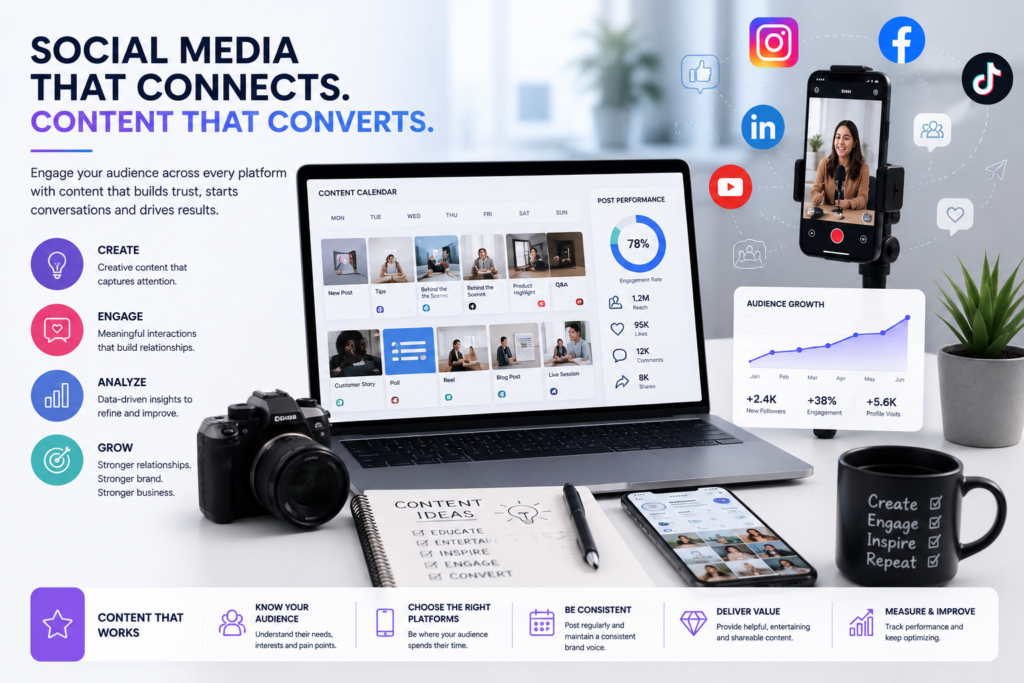
Social media marketing involves using social platforms to build awareness, engage audiences, distribute content, generate leads, and support sales.
Depending on the audience, businesses may use platforms such as:
- YouTube
- TikTok
- X
- Other emerging platforms
Social media can be particularly useful for businesses where visual storytelling, community, personality, or education influences purchasing decisions.
However, effective social media marketing is more than posting attractive graphics.
A strategy should define:
- Target audience
- Content pillars
- Brand voice
- Posting frequency
- Distribution strategy
- Community management
- Paid promotion
- Performance metrics
Businesses should choose platforms based on audience behavior rather than trying to maintain a presence everywhere.
4. Content Marketing
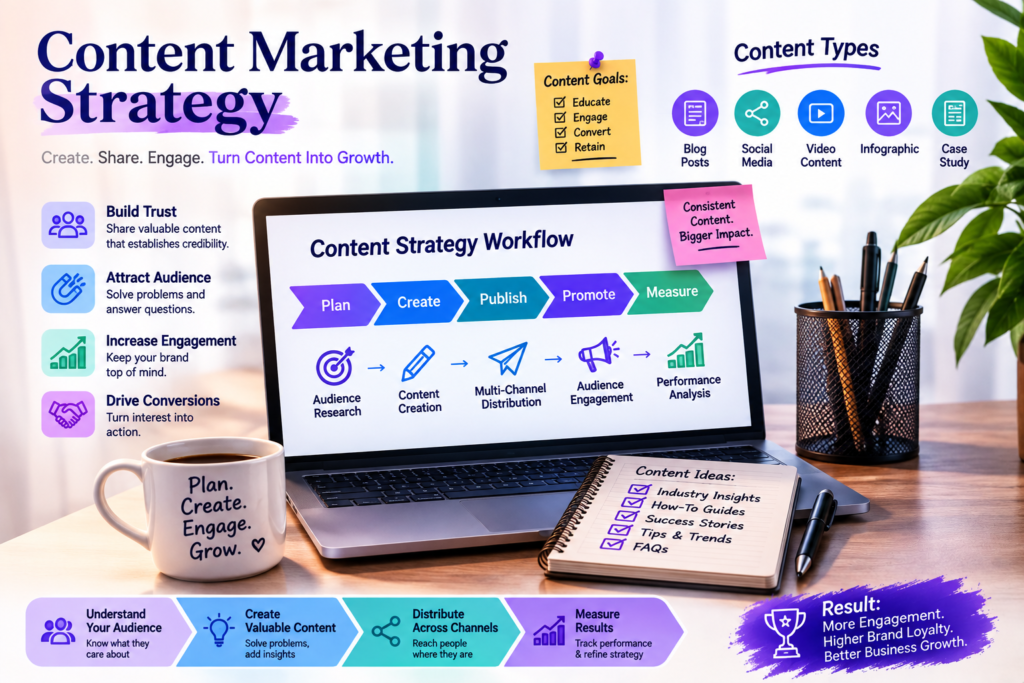
Content marketing focuses on creating and distributing valuable information to attract and retain a clearly defined audience.
Content can include:
- Blog articles
- Videos
- Guides
- Case studies
- Infographics
- Podcasts
- Newsletters
- Webinars
- Research reports
- Social media content
A strong content strategy supports several areas of digital marketing simultaneously.
It can improve organic visibility, educate prospects, establish expertise, support social media, answer customer questions, and help sales teams address objections.
The key is quality.
Businesses should not create content simply because competitors are publishing it.
Every piece should have a purpose.
Ask:
Who is this for?
What problem does it solve?
What should the reader do next?
Why should they trust us?
5. Email Marketing
Email marketing allows businesses to communicate directly with people who have opted into their audience.
It can be used for:
- Newsletters
- Product launches
- Promotions
- Educational content
- Lead nurturing
- Abandoned-cart campaigns
- Customer onboarding
- Retention
- Re-engagement
Email can become particularly valuable because businesses are not completely dependent on algorithms to reach subscribers.
A good email marketing strategy focuses on relevance rather than sending large volumes of promotional messages.
Segmentation and personalization can make communication more useful.
For example, an e-commerce brand might send different emails to:
- New subscribers
- First-time buyers
- Repeat customers
- Inactive customers
- High-value customers
6. Influencer and Affiliate Marketing
Influencer marketing involves collaborating with creators who have an established audience and influence within a specific niche.
Affiliate marketing uses partners who promote a business and receive compensation based on agreed outcomes, such as sales or leads.
Both can extend a brand’s reach beyond its existing audience.
The important consideration is relevance.
A creator with one million followers is not automatically more valuable than a creator with 20,000 highly relevant followers.
The right partnership depends on:
- Audience fit
- Trust
- Engagement
- Content quality
- Brand alignment
- Conversion potential
7. Video Marketing
Video has become an important part of modern marketing.
Businesses can use video for:
- Product demonstrations
- Tutorials
- Customer testimonials
- Educational content
- Behind-the-scenes content
- Interviews
- Short-form videos
- Webinars
- Brand storytelling
Video can also support other channels.
For example, one long-form video can become:
YouTube video → Blog article → Instagram clips → LinkedIn post → Email newsletter
This approach allows businesses to maximize the value of a single content asset.
8. Local Digital Marketing
Local businesses need a strategy designed around geographic intent.
Someone searching:
“dentist near me”
has a different intent from someone reading:
“How does teeth whitening work?”
Local digital marketing can include:
- Local SEO
- Google Business Profile optimization
- Reviews
- Location pages
- Local content
- Local search advertising
- Community engagement
For service-based businesses, local visibility can be particularly important because the customer is often ready to contact a provider within a specific geographic area.
Digital Marketing vs Traditional Marketing
Traditional marketing includes channels such as:
- Television
- Radio
- Newspapers
- Magazines
- Billboards
- Direct mail
Digital marketing uses online and digital channels such as:
- Search
- Websites
- Social media
- Online advertising
- Video
- Digital communities
The biggest distinction is not simply where the advertisement appears.
It is the amount of data and interaction available.
Digital campaigns can often be measured through impressions, clicks, traffic, conversions, engagement, leads, and revenue.
Google highlights metrics such as click-through rate, website traffic, conversion rate, cost per acquisition, and return on ad spend as useful measures for evaluating online marketing performance.
Traditional advertising can still be highly effective.
The smartest approach is often an integrated strategy rather than treating traditional and digital channels as enemies.
How to Create a Digital Marketing Strategy
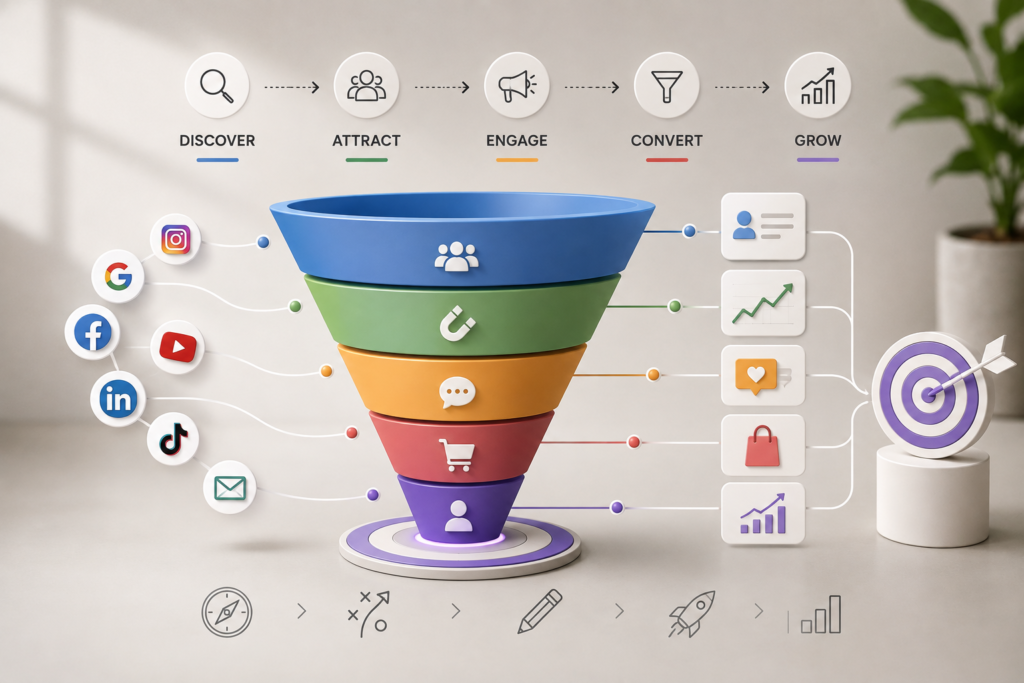
A successful digital marketing strategy should begin with business objectives.
Step 1: Define Your Goal
Avoid vague goals such as:
“We want more followers.”
Instead, establish measurable objectives:
- Generate 100 qualified leads
- Increase online sales
- Reduce customer acquisition cost
- Increase organic traffic
- Improve conversion rate
- Increase repeat purchases
Step 2: Understand Your Audience
Create a clear picture of your ideal customer.
Understand:
- Demographics
- Needs
- Problems
- Buying behavior
- Budget
- Search behavior
- Preferred platforms
- Objections
- Decision-making factors
The better you understand your audience, the more relevant your digital marketing becomes.
Step 3: Analyze Competitors
Study competitors to identify:
- Their positioning
- Content strategy
- Search visibility
- Social media presence
- Advertising approach
- Customer reviews
- Strengths
- Weaknesses
Do not simply copy them.
Look for gaps.
Step 4: Choose the Right Channels
You do not need every channel.
A B2B software company may prioritize:
SEO + LinkedIn + Content + Email
An e-commerce brand might prioritize:
Paid Social + Search + Email + Influencer Marketing
A local service business may prioritize:
Local SEO + Google Ads + Reviews + Social Media
The right channel mix depends on where your customers are and how they make decisions.
Step 5: Create a Content Plan
Build content around customer needs.
For example, an interior design business might create:
Awareness:
“What Makes a Home Feel More Personal?”
Consideration:
“10 Interior Design Mistakes to Avoid”
Decision:
“How to Choose the Right Interior Designer”
Conversion:
“Book a Design Consultation”
This creates a connected customer journey instead of random posts.
Step 6: Set a Budget
Your budget should account for:
- Content creation
- Advertising
- SEO
- Design
- Software
- Influencers
- Agency or employee costs
- Analytics
Do not decide your budget solely by copying a competitor.
Start with your business objectives and expected economics.
Step 7: Measure and Optimize
Track the metrics that connect marketing activity to business outcomes.
Do not celebrate traffic if none of it becomes customers.
Do not celebrate followers if they never engage or purchase.
A mature digital marketing strategy measures the entire journey.
Key Digital Marketing Metrics
Different channels require different KPIs.
Website Traffic
Shows how many people visit your website.
Click-Through Rate
Measures how frequently people click after seeing an ad, search result, email, or link.
Conversion Rate
Shows the percentage of visitors who complete a desired action.
Cost Per Lead
Shows how much it costs to generate a lead.
Customer Acquisition Cost
Measures the average cost of acquiring a new customer.
Return on Ad Spend
Measures revenue generated relative to advertising expenditure.
Engagement Rate
Helps evaluate interactions with social content.
Customer Lifetime Value
Estimates the value generated by a customer over the relationship.
The most useful digital marketing KPI is not necessarily the largest number.
It is the metric that helps answer an important business question.
The Role of AI in Digital Marketing in 2026
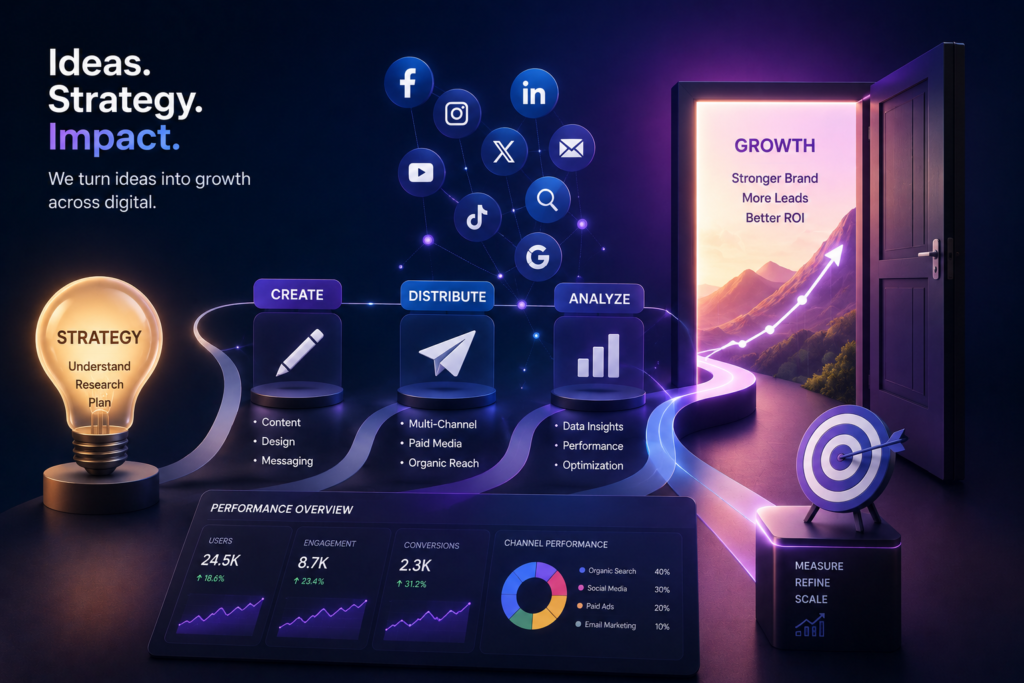
Artificial intelligence is changing how marketers research, create, analyze, and optimize campaigns.
Businesses are using AI for:
- Market research
- Audience analysis
- Content ideation
- Copy variations
- Personalization
- Data analysis
- Customer support
- Campaign optimization
- Predictive insights
- Workflow automation
Google’s current educational material also identifies AI as an increasingly important part of modern marketing workflows, including strategy development, research, campaign decisions, email creation, and testing.
However, AI should not replace strategy.
A tool can generate ten headlines in seconds.
It cannot automatically determine whether those headlines are aligned with your positioning, audience, offer, competitive environment, or brand voice.
The strongest digital marketing teams use AI to improve efficiency while keeping human judgment at the center.
Digital Marketing and GEO: The New Search Opportunity
Another major development is the growth of generative search.
Businesses are now thinking beyond traditional SEO and exploring Generative Engine Optimization (GEO).
SEO focuses on visibility in search engine results.
GEO focuses on improving how brands and information can be understood and represented within AI-generated answers.
This means content strategy increasingly needs to consider:
- Clear answers
- Expertise
- Original information
- Brand authority
- Consistent business information
- Strong topical coverage
- Useful references
- Customer questions
This does not mean SEO is disappearing.
Instead, GEO and SEO can become complementary parts of modern digital marketing.
Related internal link: Link GEO vs SEO to your previously published GEO vs SEO guide.
Common Digital Marketing Mistakes
Even businesses investing heavily in online promotion can make strategic mistakes.
1. Trying to Be Everywhere
Being present on ten platforms does not guarantee success.
Focus on the channels where your audience actually spends time.
2. Chasing Vanity Metrics
Followers and impressions can look impressive without producing revenue.
Always connect marketing activity to business objectives.
3. Ignoring SEO
Paid advertising can generate immediate visibility, but businesses should also develop long-term organic assets.
4. Publishing Without a Strategy
Random content creates activity without direction.
Every major content asset should have a purpose.
5. Not Tracking Conversions
Traffic without conversion data makes it difficult to determine what is actually working.
6. Copying Competitors
Competitor research is useful.
Copying their strategy is not.
Build a distinctive position.
7. Ignoring Existing Customers
Acquiring a new customer is only one part of growth.
Retention, repeat purchases, referrals, and loyalty matter too.
How to Improve Your Digital Marketing in 2026
Businesses looking to improve their results should focus on fundamentals before chasing every new trend.
Build a Strong Website
Your website should clearly communicate:
- What you offer
- Who you help
- Why customers should choose you
- How customers can take the next step
Create Useful Content
Answer real customer questions rather than publishing content solely for search engines.
Strengthen Search Visibility
Invest in SEO and relevant search advertising.
Build a Recognizable Brand
People are more likely to engage with businesses they remember and trust.
Use Data
Track performance consistently.
Experiment
Test different:
- Headlines
- Offers
- Creatives
- Landing pages
- Audiences
- Calls to action
Adapt
Consumer behavior and platforms change.
Your digital marketing strategy should change with them.
The Future of Digital Marketing
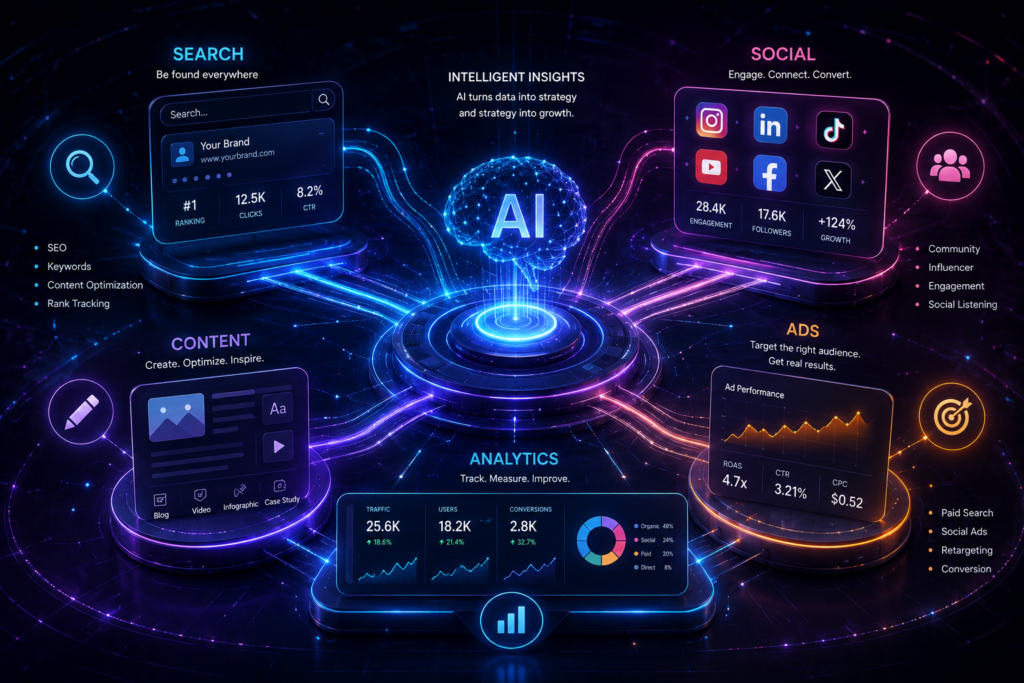
The future will not belong to one platform.
Search engines, AI assistants, social networks, video platforms, email, communities, marketplaces, and websites will increasingly overlap.
Customers may discover a business through a Google search, watch its video on YouTube, see its Instagram content, ask an AI assistant about it, read reviews, and finally visit its website.
That makes consistency increasingly important.
Your brand message, expertise, customer experience, and information should make sense across every major touchpoint.
AI will continue to automate repetitive marketing tasks, while marketers will increasingly focus on strategy, creativity, positioning, analysis, customer psychology, and decision-making.
Google’s current overview of the field similarly describes digital marketing as an evolving discipline shaped by digital platforms, analytics, AI, and changing consumer behavior.
Final Takeaway
Digital marketing is no longer simply about running advertisements or posting on social media.
It is a complete system for attracting, engaging, converting, and retaining customers through digital channels.
A strong strategy combines the right channels with clear business objectives, useful content, audience understanding, measurement, experimentation, and continuous improvement.
Businesses should not ask:
“Which digital marketing channel should we use?”
They should ask:
“How do our customers discover, evaluate, choose, and stay connected with our business—and how can we improve every stage of that journey?”
That question leads to a much stronger strategy.
In 2026, successful digital marketing will be increasingly integrated, data-driven, customer-focused, and AI-assisted.
The businesses that win will not necessarily be those that publish the most content or spend the most money.
They will be the businesses that understand their customers, communicate their value clearly, build trust consistently, measure what matters, and continuously improve.
That is what makes digital marketing a long-term growth engine rather than simply another promotional activity.
Frequently Asked Questions About Digital Marketing
1. What is digital marketing?
Digital marketing is the use of digital channels and technologies to promote products, services, brands, and businesses, while attracting, engaging, converting, and retaining customers.
2. What are the main types of digital marketing?
The major types include SEO, PPC and search advertising, social media marketing, content marketing, email marketing, influencer marketing, affiliate marketing, video marketing, local marketing, and online reputation management.
3. Why is digital marketing important for businesses?
It allows businesses to reach specific audiences, communicate directly with customers, measure campaign performance, generate leads, increase sales, and build long-term relationships.
4. Is digital marketing better than traditional marketing?
Neither is automatically better. The right approach depends on the business, audience, objectives, budget, and customer journey. Many companies benefit from combining traditional and digital channels.
5. How much does digital marketing cost?
There is no universal price. Costs depend on the channels used, business goals, market competition, advertising budget, content requirements, agency fees, and desired results.
6. How long does digital marketing take to show results?
Paid advertising can produce results quickly, while SEO, content marketing, brand building, and organic social media generally require more time and consistent effort. The timeframe depends on the channel and business.
7. Is SEO part of digital marketing?
Yes. SEO is one of the core components of digital marketing. It focuses on improving a website’s organic visibility in search engines.
8. Is social media marketing part of digital marketing?
Yes. Social media marketing is a major digital channel used for awareness, engagement, community building, traffic, lead generation, and sales.
9. How does AI affect digital marketing?
AI can help marketers with research, content creation, personalization, analysis, automation, campaign optimization, and customer interactions. Human strategy and judgment remain important.
10. What is the most effective digital marketing strategy?
There is no universal strategy. The most effective approach is one aligned with your target audience, business objectives, customer journey, budget, competitive environment, and measurable outcomes.
11. How do I measure digital marketing success?
Use relevant KPIs such as traffic, leads, conversion rate, customer acquisition cost, revenue, return on ad spend, engagement, and customer lifetime value.
12. Is digital marketing important for small businesses?
Yes. Small businesses can use SEO, local search, social media, email, content, paid advertising, and other channels to compete for attention and reach highly targeted audiences.