
GEO vs SEO: What Do They Mean?
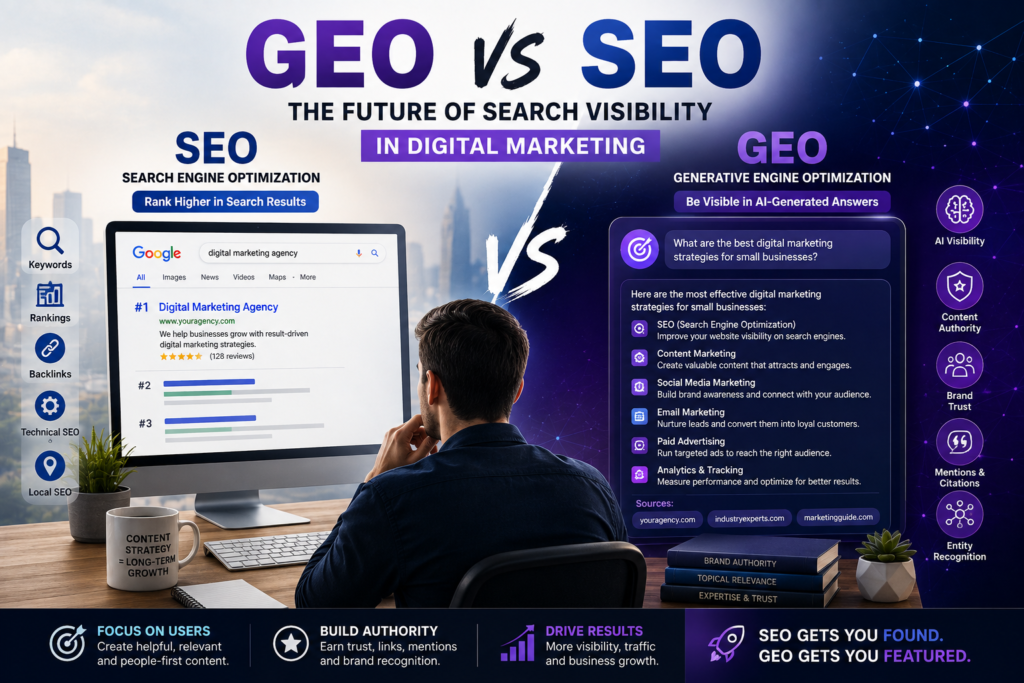
GEO vs SEO is becoming one of the most discussed topics in modern digital marketing as search behavior moves beyond traditional search engines and into AI-powered experiences. Businesses that once focused almost entirely on Google rankings now need to understand how people discover information through generative AI, conversational search, social platforms, videos, and other digital channels.
Before comparing the two strategies, it is important to understand what SEO and GEO actually mean.
What Is SEO?
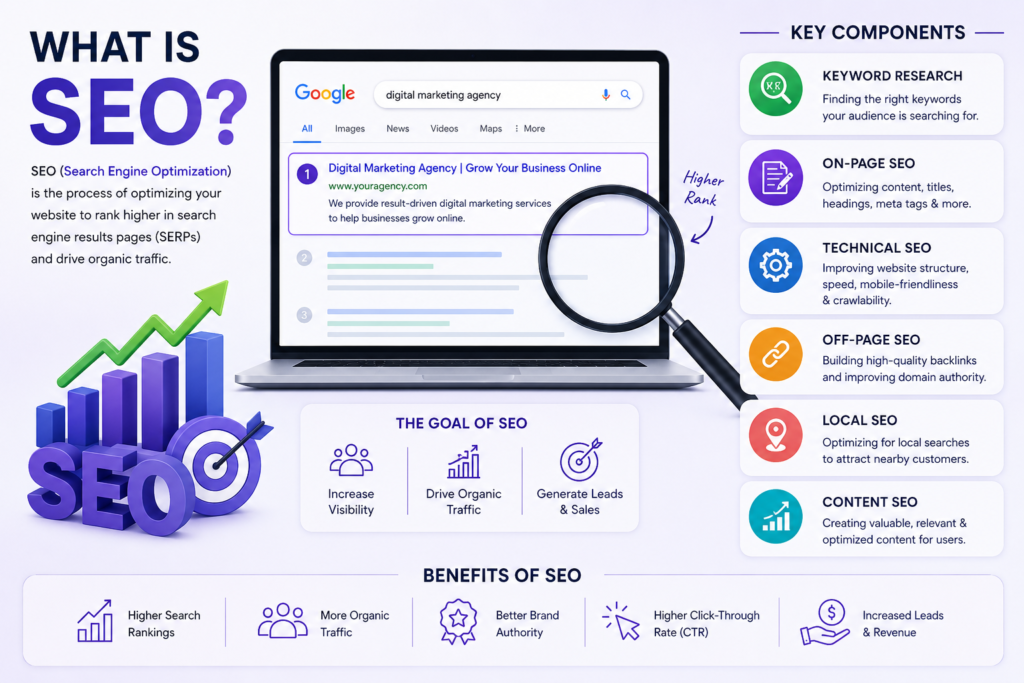
SEO stands for Search Engine Optimization.
Search Engine Optimization is the process of improving a website and its content so that search engines can discover, understand, index, and potentially rank its pages for relevant searches.
In simple terms, SEO helps a website become more visible when people search for information, products, services, or solutions related to a business.
For example, imagine someone searches:
“Best digital marketing agency for small businesses.”
A company offering digital marketing services can optimize its website around relevant topics and search intent, improve technical SEO, publish useful content, build authority, and make its website easier for search engines to understand.
SEO commonly includes:
- Keyword research
- Search intent analysis
- On-page SEO
- Technical SEO
- Content optimization
- Internal linking
- Backlink building
- Local SEO
- Website architecture
- Metadata
- Image optimization
- Structured data
- Mobile optimization
For a deeper understanding of SEO fundamentals, businesses can refer to the official Google SEO Starter Guide.
What Is GEO?
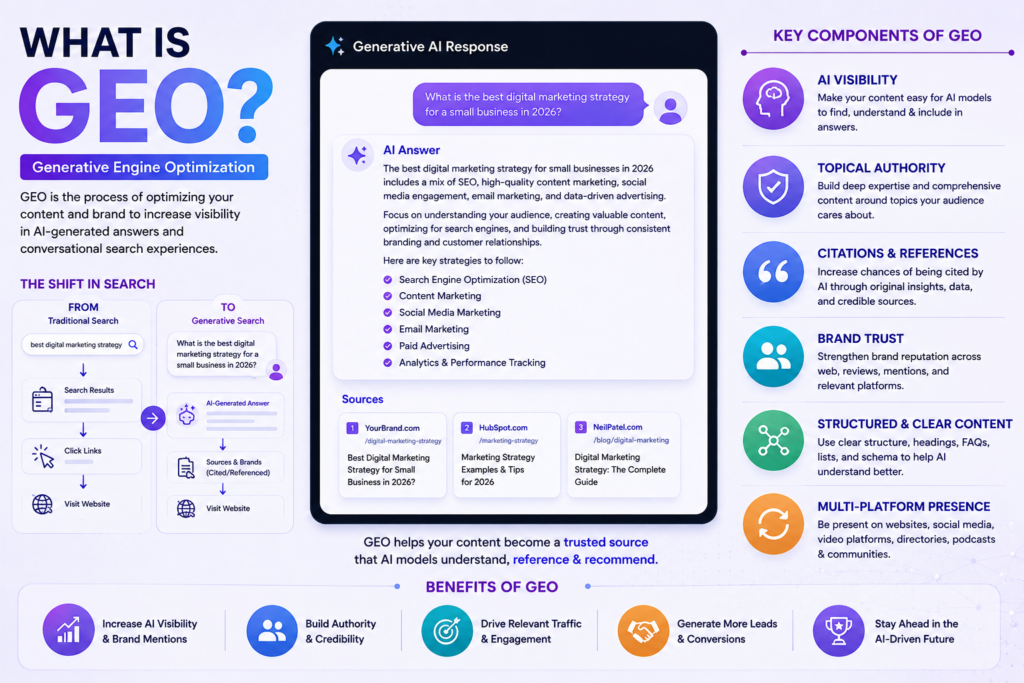
GEO stands for Generative Engine Optimization.
Generative Engine Optimization refers to strategies designed to improve how a brand, website, content, product, service, or expert information can be understood, surfaced, referenced, or represented by generative AI systems.
In simple terms:
SEO focuses primarily on visibility in search results, while GEO focuses on visibility within generative AI answers and AI-powered search experiences.
For example, instead of searching:
“digital marketing strategies for startups”
a user might ask an AI-powered search system:
“What are the most effective digital marketing strategies for a startup with a limited budget?”
Instead of displaying only a traditional list of webpages, a generative system can produce a synthesized response using information from multiple sources.
This creates another layer of visibility for businesses.
Instead of asking only:
“How can we rank this page?”
marketers also need to consider:
“How can we become a credible and useful source that AI systems can understand and reference?”
That is the central idea behind GEO.
Google’s current guidance confirms that SEO remains relevant to generative AI features in Google Search because those experiences continue to rely on Google’s core search ranking and quality systems.
GEO vs SEO: What Is the Difference?
The easiest way to understand GEO vs SEO is to look at their primary objectives.
SEO focuses on improving a website’s visibility in traditional search results.
GEO focuses on improving how a brand and its information can be represented within generative AI answers.
However, they are not completely separate disciplines.
Both depend on many of the same foundations:
- Helpful content
- Strong topical relevance
- Clear information
- Expertise
- Authority
- Website accessibility
- Brand credibility
- Original insights
- Good user experience
- Consistent information
This is why businesses should not think of GEO as a replacement for SEO.
Instead, GEO expands the traditional search strategy.
Google’s 2026 documentation specifically states that SEO best practices remain relevant for generative AI features in Search. Google also recommends providing valuable, unique, non-commodity content and explains that there are no special technical requirements that replace the fundamentals of search optimization.
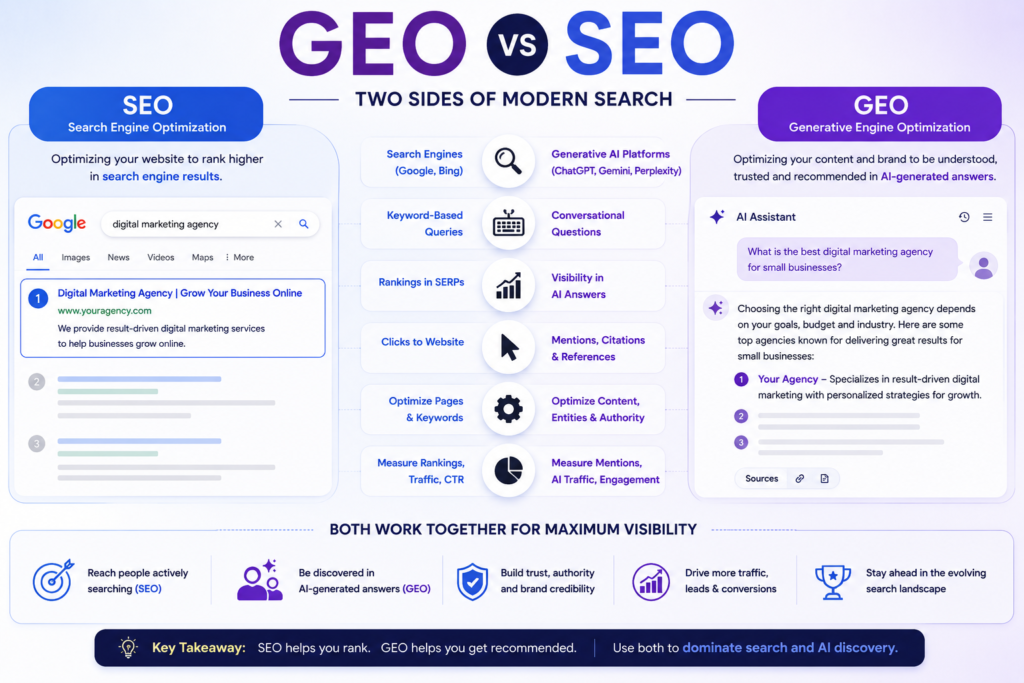
GEO vs SEO: A Detailed Comparison
| Factor | SEO | GEO |
|---|---|---|
| Full form | Search Engine Optimization | Generative Engine Optimization |
| Primary focus | Search engine visibility | Generative AI visibility |
| Main objective | Improve rankings and organic traffic | Improve chances of being represented or cited in AI answers |
| Search format | Keywords and search queries | Conversational questions and prompts |
| Content focus | Search intent and relevance | Authority, clarity, context and answerability |
| Visibility | Search results | AI-generated responses |
| Authority signals | Links, expertise and reputation | Expertise, reputation, references and corroborating information |
| Technical optimization | Essential | Still important |
| Brand authority | Important | Increasingly important |
| Measurement | Rankings, clicks and impressions | Mentions, citations, AI visibility and referral traffic |
| Status | Established discipline | Emerging optimization approach |
The difference is important, but businesses should avoid treating the two strategies as competing marketing channels.
A strong SEO foundation can support visibility in generative search as well.
Why GEO Is Becoming Important in Digital Marketing
The biggest reason businesses are paying attention to GEO is the changing way people search.
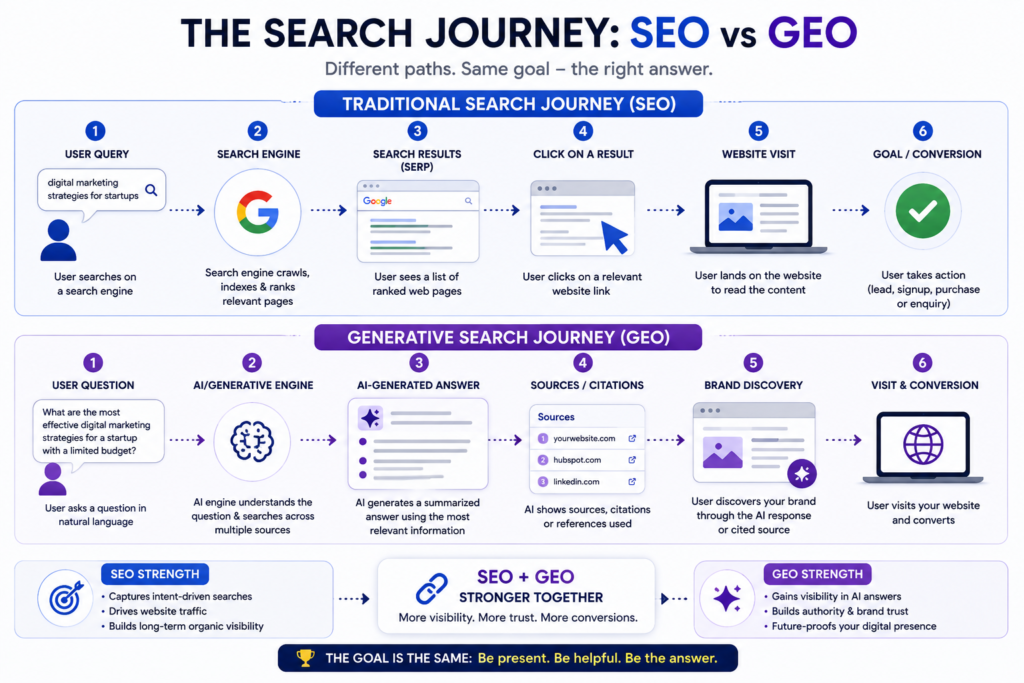
Traditional search often follows this journey:
Question → Search engine → Search results → Website → Answer
Generative search can look more like:
Question → AI system → Synthesized answer → Sources or brands → Possible website visit
This change affects the way businesses approach digital marketing.
Imagine a potential customer wants to hire a marketing agency.
They might search:
“digital marketing agency near me.”
But they could also ask:
“What should I look for when choosing a digital marketing agency for my small business?”
An AI system may respond with information about:
- Services
- Experience
- Pricing
- Industry expertise
- Reviews
- Questions to ask an agency
- Warning signs
- Recommended companies
The discovery journey becomes more conversational.
This means businesses need to think beyond individual keywords and focus on questions, entities, expertise, context, reputation, and useful information.
Google’s latest guidance for generative AI search also highlights the importance of unique, valuable content and explains how established SEO practices remain relevant.
Why SEO Still Matters in the Age of AI
One of the biggest misconceptions surrounding GEO vs SEO is that the rise of generative AI makes SEO obsolete.
It does not.
SEO remains a fundamental part of digital marketing.
Search engines still need to discover, crawl, understand, organize, and evaluate information across the web.
A website with:
- Poor navigation
- Inaccessible pages
- Thin content
- Weak technical foundations
- Confusing structure
- Missing important information
will not automatically become successful simply because its owner starts thinking about GEO.
SEO provides the foundation.
Businesses should continue focusing on:
- Crawlability
- Indexability
- Internal linking
- Page structure
- Relevant titles
- Helpful content
- Mobile usability
- Website performance
- Structured data where appropriate
- Clear navigation
Google’s documentation continues to emphasize these fundamental SEO principles, while its newer AI-search guidance explicitly says SEO remains relevant for generative AI features.
Internal link opportunity: Link the phrase “SEO fundamentals” to your website’s existing /seo/ or SEO services page.
GEO vs SEO: How Search Intent Changes the Strategy
Search intent has always been important for SEO.
It becomes even more valuable when considering generative search.
Search intent refers to the reason behind a person’s search.
A user may want to:
Find Information
“What is digital marketing?”
Compare Options
“SEO vs PPC—which is better?”
Find a Service
“digital marketing agency for startups”
Make a Purchase
“best SEO package for small businesses”
Solve a Problem
“Why is my website getting traffic but no leads?”
A strong digital marketing strategy should create content for these different intentions.
Instead of creating one page and forcing it to rank for every possible keyword, businesses should build resources that answer specific customer needs.
This is where GEO and SEO work particularly well together.
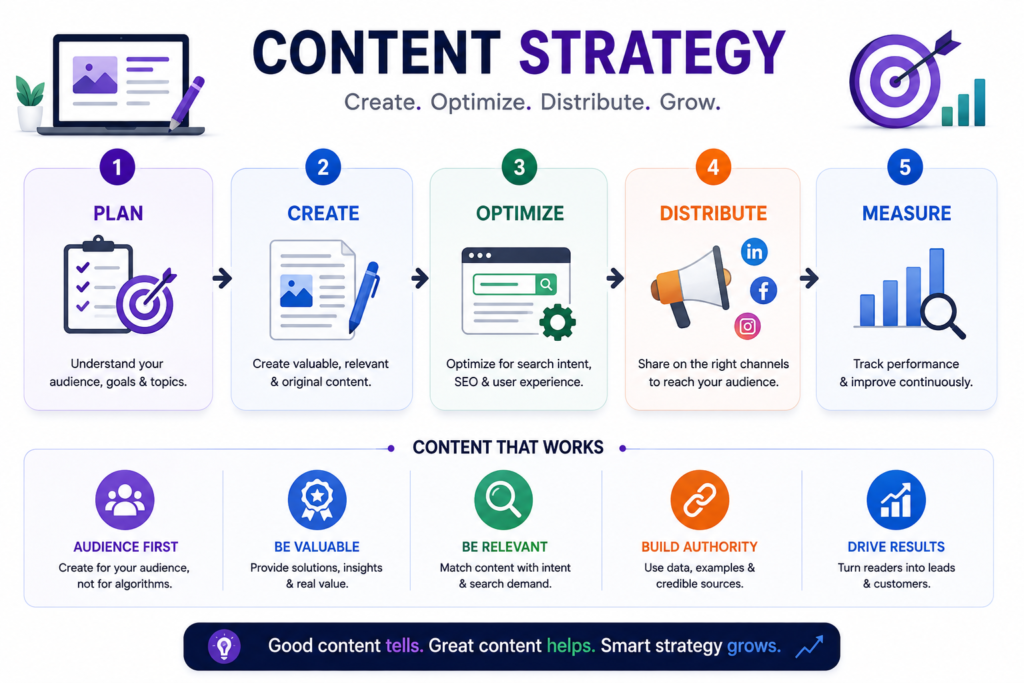
How to Create Content for GEO and SEO
There is no guaranteed formula that forces an AI system to mention a particular brand.
However, businesses can follow practical principles that make their information clearer, more useful, and easier to understand.
1. Answer Questions Directly
Do not make readers search through several paragraphs for a basic answer.
Start with a clear explanation and then provide additional context.
For example:
What is GEO?
GEO stands for Generative Engine Optimization. It refers to strategies designed to improve how a brand or its information can be surfaced and represented within generative AI search experiences.
Then explain the topic in greater depth.
This improves readability and creates a clearer content structure.
2. Build Comprehensive Content
Long content is not automatically better content.
The goal should be completeness and usefulness.
If someone asks:
“How do I create a digital marketing strategy?”
a useful guide should discuss:
- Business goals
- Target audience
- Competitors
- Positioning
- Marketing channels
- Content
- SEO
- Social media
- Paid advertising
- Budget
- Analytics
- Conversion tracking
- Optimization
This gives the reader a complete resource rather than a shallow answer.
3. Demonstrate Real Expertise
One of the biggest challenges in content marketing is differentiation.
AI can generate generic explanations quickly.
Therefore, brands need to provide something more valuable than information that can be found everywhere.
Include:
- Original research
- Case studies
- Expert opinions
- First-hand experience
- Industry observations
- Data
- Unique frameworks
- Customer examples
- Practical lessons
For example, instead of saying:
“Social media is important for businesses.”
an experienced marketer can explain which platforms work for specific business models, which metrics actually matter, and where businesses commonly waste their advertising budgets.
That creates genuine expertise.
GEO vs SEO: Why Topical Authority Matters
A website should demonstrate expertise across a subject instead of publishing one isolated article.
Suppose a business specializes in digital marketing.
It could build content around several related topics.
SEO Content
- What is SEO?
- On-page SEO
- Technical SEO
- Local SEO
- Off-page SEO
- SEO strategy
Content Marketing
- Content strategy
- Blogging
- Content calendars
- Content distribution
Social Media Marketing
- Instagram marketing
- LinkedIn marketing
- Social media strategy
- Social media analytics
Paid Advertising
- Google Ads
- PPC strategy
- Meta advertising
- Conversion tracking
AI Search
- What is GEO?
- GEO vs SEO
- AI search
- Generative search
- AI visibility
These connected resources can demonstrate broader topical expertise.
Internal link opportunity: Link relevant mentions of content marketing, SEO, and social media marketing to your corresponding service or educational pages.
How Brand Authority Supports GEO and SEO
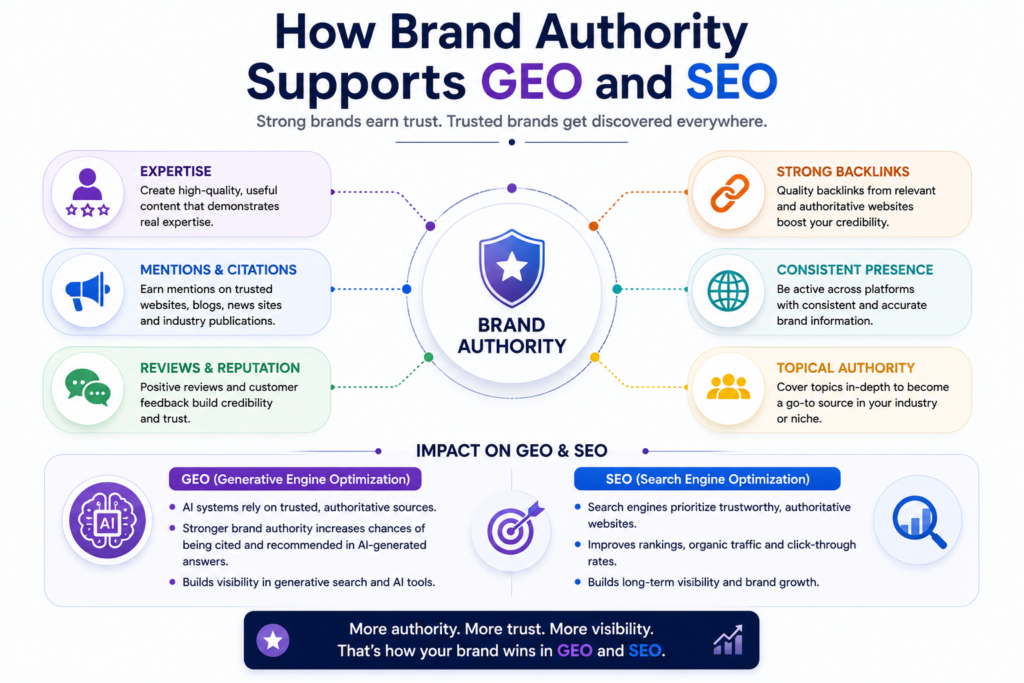
Traditional SEO has often focused heavily on links and rankings.
Those remain important, but modern digital marketing requires a broader view of authority.
People may encounter a brand through:
- Search engines
- News websites
- Industry publications
- Reviews
- Podcasts
- YouTube
- Social media
- Business directories
- Professional communities
- Customer recommendations
- Partner websites
A company that consistently provides accurate and useful information across relevant channels can develop stronger brand recognition.
This is particularly important for GEO because generative systems need enough context to understand what a business does, what it is known for, and whether its information is relevant to a particular question.
Google’s current guidance also emphasizes the importance of valuable, unique content and other forms of useful information beyond basic text, including local, shopping, image, and video content.
Does Keyword Density Matter for GEO?
Keyword relevance still matters in SEO, but keyword repetition should not become the strategy.
There is no universal keyword-density percentage that guarantees rankings or AI visibility.
Excessive repetition can make content difficult to read and may create a keyword-stuffed experience.
For example, this is poor writing:
“Digital marketing helps digital marketing businesses improve digital marketing results through digital marketing strategies.”
It sounds unnatural.
Instead, use the focus keyphrase naturally and cover related concepts.
For this article, related terms include:
- Search engine optimization
- Generative AI
- AI search
- Organic search
- Search visibility
- Content authority
- Brand visibility
- Search intent
- AI-generated answers
- Online marketing
- Search strategy
This creates a richer topic without sacrificing readability.
GEO vs SEO: The Role of Structured Data
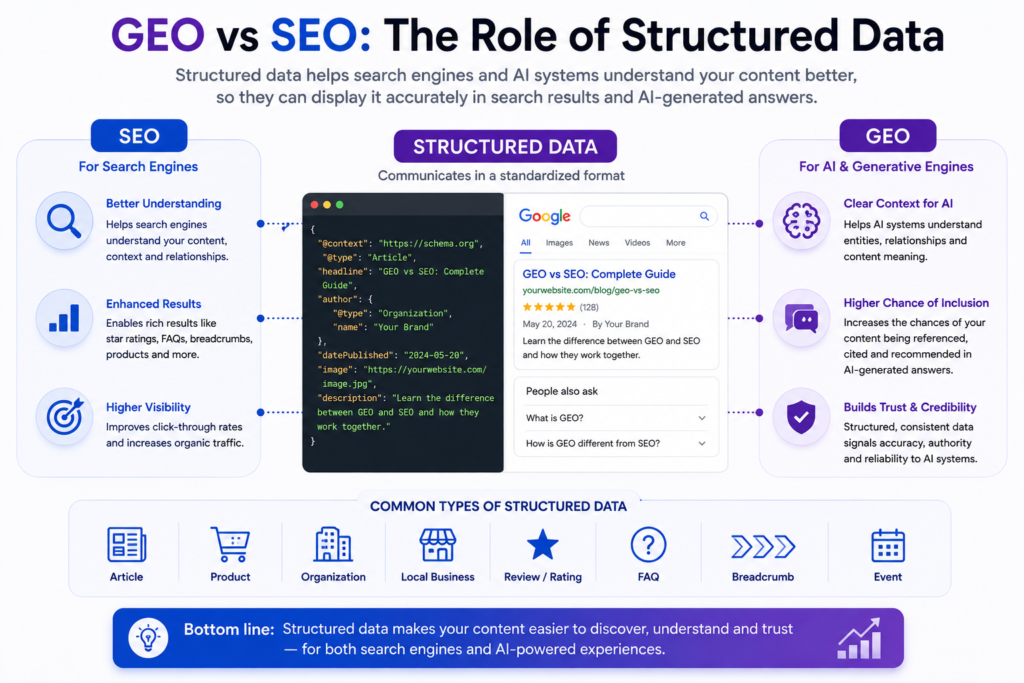
Structured data helps search engines understand specific information on a webpage.
Depending on the page, structured data can communicate information about:
- Articles
- Products
- Organizations
- Events
- Local businesses
- Breadcrumbs
- Other supported content types
Structured data should not be treated as a secret GEO hack.
Its purpose is to communicate information in a standardized format.
Businesses should implement structured data accurately and follow the relevant search-engine documentation.
Outbound resource: For official guidance, see Google’s Introduction to structured data.
A technically sound website remains an important part of digital marketing even as search becomes more AI-driven.
How to Optimize a Website for GEO and SEO
A practical optimization strategy can be divided into several stages.
Stage 1: Audit Existing Content
Review your most important pages.
Ask:
- Is the information accurate?
- Is it current?
- Does the page answer the user’s question?
- Is the content original?
- Does it demonstrate expertise?
- Is the information easy to find?
- Are relevant internal links included?
- Are supporting sources provided?
Improve weak content instead of simply publishing more pages.
Stage 2: Research Customer Questions
Do not only research keywords.
Research actual questions.
Useful sources can include:
- Search suggestions
- Customer conversations
- Sales calls
- Reviews
- Support queries
- Industry forums
- Social media discussions
- Competitor FAQs
These sources reveal how real people describe their problems.
Stage 3: Create Problem-Solving Content
Instead of asking:
“What keyword should we target?”
also ask:
“What problem can we solve?”
For example:
Problem: Website traffic is increasing but leads are not.
A useful article could explain:
- Traffic quality
- Search intent
- Landing pages
- Calls to action
- Conversion tracking
- User experience
- Lead qualification
This is much more valuable than repeating a phrase such as “increase website leads.”
Stage 4: Strengthen Existing Pages
Not every SEO opportunity requires a new article.
Update important pages with:
- Better explanations
- New examples
- Updated statistics
- FAQs
- Original insights
- Internal links
- Relevant references
- Updated screenshots
- Better headings
Regular content improvement can be an effective part of long-term digital marketing.
GEO vs SEO: How to Build an AI-Ready Content Strategy
An AI-ready content strategy does not mean producing thousands of AI-written articles.
Instead, it means creating information that is:
Useful + Original + Clear + Accurate + Relevant + Trustworthy
Start by identifying your core areas of expertise.
Then map the questions your customers ask around those subjects.
For each topic, create content at different levels.
Beginner Content
Explain the basic concept.
Educational Content
Explain how the concept works.
Comparison Content
Compare available options.
Practical Content
Show how to implement it.
Advanced Content
Discuss strategy, analysis, and optimization.
Commercial Content
Explain how your business can help.
This creates a connected content ecosystem.
Internal link opportunity: Link this section to your existing digital marketing services, content marketing, or SEO services pages.
The Importance of Original Information
The internet already contains millions of articles about common topics.
Publishing another generic article may add little value.
Original information can make your content more distinctive.
For example, a marketing agency could publish:
“What We Learned After Managing 50 Local Business Campaigns.”
The article could include:
- Common mistakes
- Campaign patterns
- Budget observations
- Conversion challenges
- Successful approaches
- Industry-specific lessons
This type of content provides information that is difficult to replicate through generic content generation.
Original insights can therefore become a competitive advantage in modern digital marketing.
GEO vs SEO: Common Mistakes to Avoid
Mistake 1: Believing There Is a Guaranteed GEO Hack
There is no guaranteed formula that forces an AI system to cite your website.
Be cautious of anyone promising guaranteed AI visibility.
Mistake 2: Publishing Huge Amounts of Generic AI Content
AI can make content production faster, but speed does not automatically create quality.
Google’s guidance emphasizes useful, original content rather than content produced primarily to manipulate search visibility.
Mistake 3: Abandoning SEO
GEO does not make SEO irrelevant.
Google’s own documentation confirms that established SEO practices remain important for generative AI search experiences.
Mistake 4: Focusing Only on Keywords
Keywords are useful, but they do not fully describe user intent.
Modern digital marketing needs to consider the customer’s questions, problems, context, and desired outcomes.
Mistake 5: Ignoring Brand Authority
A website alone does not define a company’s reputation.
Relevant mentions, reviews, references, expertise, and consistent information can all contribute to stronger brand recognition.
Mistake 6: Writing Only for Search Engines
Your ultimate audience is still human.
If content is repetitive, vague, confusing, or difficult to read, optimization loses its value.
GEO vs SEO for Small Businesses
Small businesses often operate with limited marketing budgets.
They therefore need to prioritize the fundamentals.
A practical approach is:
- Build a professional website.
- Clearly explain your products or services.
- Optimize your important pages.
- Create useful educational content.
- Strengthen local visibility where relevant.
- Collect genuine reviews.
- Maintain consistent business information.
- Publish expertise-driven content.
- Track leads and conversions.
- Expand gradually into AI-search visibility.
Small businesses do not necessarily need a separate GEO department.
Many GEO principles can be incorporated into an existing SEO and content strategy.
GEO vs SEO for E-Commerce Businesses
E-commerce search is also becoming increasingly conversational.
Instead of searching only:
“best laptop under ₹80,000”
a customer might ask:
“Which laptop under ₹80,000 is best for graphic design and video editing?”
The second question requires context.
E-commerce businesses should therefore provide detailed and accurate product information, including:
- Product specifications
- Features
- Benefits
- Pricing
- Availability
- Reviews
- Comparisons
- Frequently asked questions
- High-quality images
- Accurate categories
Better product information can support both traditional search visibility and AI-assisted discovery.
GEO vs SEO for Local Businesses
Local businesses should continue investing in local SEO.
A customer may search:
“digital marketing agency near me.”
They may also ask:
“What are the best digital marketing agencies in my city for a small business?”
This makes accurate business information and reputation particularly important.
Local businesses should maintain consistent information across relevant platforms and create genuinely useful location-specific content.
For example, a marketing agency could publish:
“Digital Marketing Strategies for Gurgaon Businesses.”
The article could discuss:
- Local competition
- Customer behavior
- Local SEO
- Social media
- Paid advertising
- Lead generation
- Industry-specific challenges
The objective should be useful local expertise rather than creating hundreds of thin location pages.
How to Measure SEO Performance
GEO vs SEO performance measurement showing rankings, AI mentions, traffic and conversions
SEO has relatively established measurement systems.
Businesses can track:
Organic Impressions
How frequently pages appear in search results.
Rankings
Where pages appear for relevant searches.
Organic Clicks
How many people visit from search.
Click-Through Rate
The percentage of impressions that result in clicks.
Organic Conversions
How many leads, purchases, enquiries, signups, or other desired actions originate from organic search.
Backlinks
Relevant external links pointing toward your website.
These metrics help marketers understand whether their SEO strategy is contributing to meaningful business outcomes.
How to Measure GEO Performance
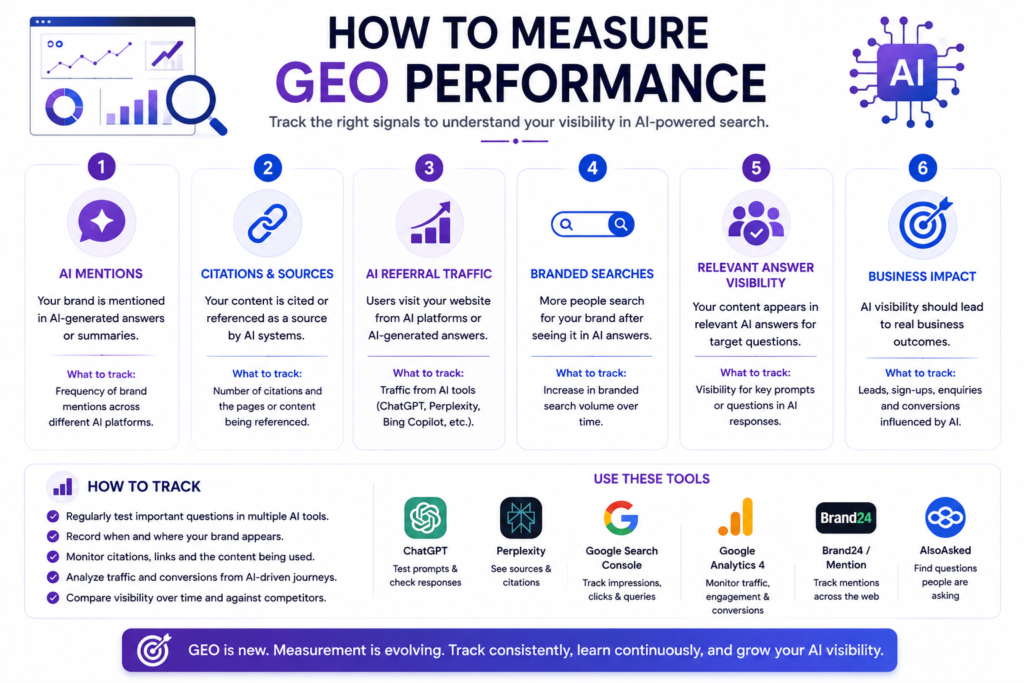
GEO measurement is still evolving.
There is currently no single universally accepted GEO score.
Businesses can instead monitor several indicators.
AI Mentions
Does your brand appear when relevant questions are asked?
Citations
Is your website referenced as a source?
AI Referral Traffic
Are visitors reaching your website from AI platforms?
Branded Searches
Are more people searching for your brand after discovering it through AI?
Qualified Leads
Does AI-driven discovery contribute to relevant enquiries?
Conversions
Does AI visibility eventually contribute to business results?
The important point is that visibility alone is not the final objective.
The objective of digital marketing is ultimately to generate meaningful business growth.
GEO vs SEO: The Future of Search
The traditional search journey has often looked like:
Query → Search results → Website → Conversion
The emerging journey can look more like:
Question → AI-generated answer → Source or brand → Website → Conversion
But this does not mean websites are disappearing.
Instead, discovery is becoming more fragmented.
People can discover brands through:
- Search engines
- AI assistants
- Social media
- Video platforms
- Online communities
- Marketplaces
- Reviews
- Podcasts
- News
- Recommendations
This makes an integrated digital marketing strategy more important than ever.
Google’s 2026 updates also show how search is expanding across websites, social content, video, AI Overviews, and AI Mode.
Should Businesses Invest in GEO or SEO First?
For most businesses, the answer is:
Build SEO fundamentals first, then expand into GEO.
Why?
Because strong generative visibility still depends on having strong underlying information.
You need:
- A credible website
- Useful content
- Clear business information
- Strong expertise
- Technical accessibility
- Consistent brand information
- Relevant authority
Without these foundations, GEO efforts cannot compensate for fundamental weaknesses.
SEO provides the foundation.
GEO expands the strategy.
A Practical GEO vs SEO Strategy for 2026
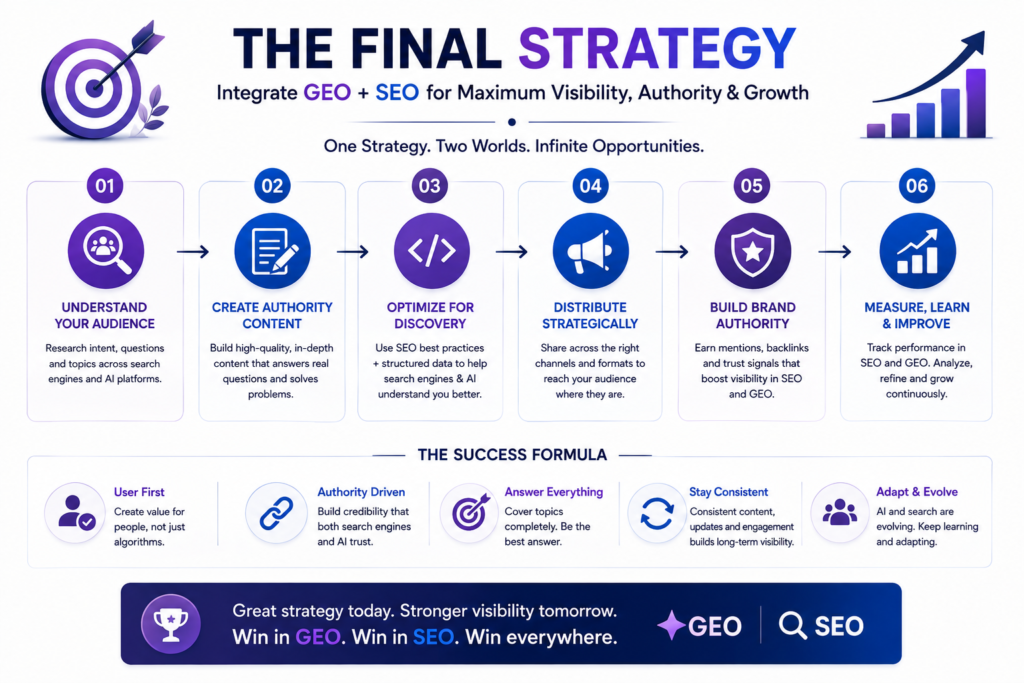
Businesses can follow this framework.
Step 1: Define Core Topics
Identify the subjects your business genuinely understands.
Step 2: Map Customer Questions
Turn those subjects into real questions customers ask.
Step 3: Create Comprehensive Resources
Build detailed pages that answer those questions.
Step 4: Add Original Expertise
Use data, examples, case studies, opinions, and first-hand experience.
Step 5: Strengthen Technical SEO
Make content accessible, crawlable, indexable, and easy to navigate.
Step 6: Build Internal Links
Connect related articles, service pages, and resources.
Step 7: Build Real Authority
Earn legitimate mentions, references, reviews, partnerships, and industry coverage.
Step 8: Keep Content Updated
Review important pages regularly.
Step 9: Track Search Performance
Monitor rankings, traffic, engagement, leads, and conversions.
Step 10: Monitor AI Visibility
Test relevant questions across generative search experiences and document how your brand is represented.
This framework combines traditional search optimization with the emerging requirements of AI-powered discovery.
GEO vs SEO: Which One Is Better?
There is no universal winner in the GEO vs SEO debate.
SEO is essential when the goal is to improve webpage visibility in traditional search.
GEO is useful when businesses want to understand and improve their presence within generative AI discovery.
But the better question is not:
“Should we choose SEO or GEO?”
The better question is:
“How can we build a digital presence that works across traditional and generative search?”
That shift in thinking is important.
The future belongs to businesses that can provide useful information wherever their customers look for answers.
GEO vs SEO: Final Takeaway
SEO stands for Search Engine Optimization.
GEO stands for Generative Engine Optimization.
SEO focuses primarily on improving the visibility and discoverability of webpages in search engines.
GEO focuses on how brands, information, and expertise can be surfaced and represented within generative AI experiences.
The two approaches overlap significantly.
Both benefit from:
- Helpful content
- Expertise
- Authority
- Relevance
- Clear communication
- Strong website foundations
- Original information
- Consistent brand signals
Businesses should not abandon SEO simply because AI search is growing.
Instead, they should build a strong SEO foundation and expand their strategy toward AI-driven discovery.
Create content that answers real questions.
Demonstrate genuine expertise.
Publish original insights.
Build topical authority.
Strengthen your brand.
Maintain accurate information.
Make your website technically sound.
Build legitimate authority.
Most importantly, create resources that people actually find useful.
The future of digital marketing is not simply about ranking a webpage.
It is about building a brand that can be discovered, understood, trusted, and recommended across an increasingly complex digital ecosystem.
Frequently Asked Questions About GEO vs SEO
1. What is the full form of SEO?
SEO stands for Search Engine Optimization. It is the process of improving websites and their content to increase visibility in search engine results.
2. What is the full form of GEO?
GEO stands for Generative Engine Optimization. It refers to strategies designed to improve how brands and their information can be surfaced or represented within generative AI search experiences.
3. What is the main difference between GEO vs SEO?
SEO primarily focuses on improving visibility in traditional search results, while GEO focuses on improving visibility and representation within AI-generated answers.
4. Is GEO replacing SEO?
No. GEO should not be considered a replacement for SEO. Google’s current guidance explicitly states that established SEO best practices remain relevant to its generative AI search features.
5. Which is more important, GEO or SEO?
For most businesses, SEO remains an essential foundation. GEO can then be incorporated to prepare the business for AI-driven search and discovery.
6. Does GEO require completely different content?
No. High-quality content can support both. GEO places additional emphasis on clear answers, context, expertise, originality, and comprehensive information.
7. Does keyword research matter for GEO?
Yes, keyword research can help marketers understand what audiences search for. However, GEO requires a broader understanding of natural-language questions, topics, entities, context, and intent.
8. Does keyword density improve GEO?
There is no established keyword-density percentage that guarantees GEO visibility. Natural usage and topical relevance are more important than repeatedly inserting the same phrase.
9. How can I improve my website for GEO?
Create useful and original content, answer customer questions clearly, demonstrate expertise, build topical authority, maintain accurate business information, and continue following strong technical SEO practices.
10. Can small businesses benefit from GEO?
Yes. Small businesses can build GEO-ready visibility by publishing expertise-driven content, answering customer questions, maintaining consistent business information, and developing a credible online presence.
11. How do you measure GEO?
GEO can be measured through AI mentions, citations, AI referral traffic, branded searches, relevant-answer visibility, qualified leads, and conversions influenced by AI discovery.
12. Is GEO just another name for SEO?
No. GEO and SEO overlap, but they have different primary focuses. SEO is centered on search-engine visibility, while GEO focuses specifically on generative AI and answer-based discovery.
13. Does technical SEO matter for GEO?
Yes. Technical accessibility remains important because search and AI systems need to access and interpret website information.
14. Should businesses create separate GEO content?
Not necessarily. Existing SEO content can often be improved for generative search by making it more useful, comprehensive, authoritative, clear, and directly relevant to customer questions.
15. What is the future of digital marketing with GEO?
The future of digital marketing will likely involve traditional search alongside AI search, social platforms, video, marketplaces, communities, and other discovery channels. Businesses will need to build authority across this broader ecosystem.